
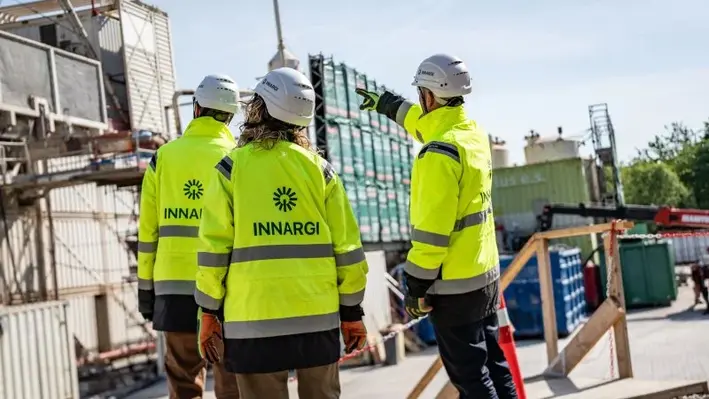
 Innargi has been granted a permit to explore and extract geothermal energy in Virum, clearing a key regulatory hurdle for its partnership with Vestforbrænding to supply new district heating areas with geothermal heat
The permit was issued by the Danish Energy Agency and is a prerequisite for advancing the joint project.
Vestforbrænding, Denmark’s largest waste-to-energy company, provides services to around one million residents across 19 municipalities on Zealand. Under its Varmeplan 2030 strategy, the company plans a major expansion of district heating that will allow approximately 39,000 households to switch from gas and oil boilers to district heating. Geothermal energy is expected to play an important role as one of the future heat sources feeding Vestforbrænding’s network.
Supplying district heating from geothermal sources
The planned geothermal facility in Virum is designed to supply climate-friendly district heating equivalent to the consumption of around 10,000 households. Innargi, which specialises in geothermal energy, will be responsible for drilling the wells and for the construction and operation of the geothermal plant. Vestforbrænding will then distribute the heat to customers through its local district heating infrastructure.
"We are very pleased that Innargi has now received permission from the Danish Energy Agency – exactly as expected. This brings us one step closer to securing the necessary heat for new customers in Virum from geothermal energy," commented Per Wulff, Head of Strategic Energy Development at Vestforbrænding
Targeting the Bunter sandstone reservoir
In Virum, the project involves drilling to the Triassic Bunter sandstone reservoir at a depth of about 2,300 meters, where geothermal water with a temperature of roughly 73 degrees Celsius is expected. The hot water will be brought to the surface, and its heat will be transferred to the district heating system using heat exchangers and heat pumps. After the heat is extracted, the cooled water will be reinjected into the subsurface, allowing it to reheat naturally.
“We have chosen to drill for the Triassic Bunter sandstone reservoir because we know from the wells and production carried out at Margretheholm on Amager that there is a geothermal reservoir with good properties. It is possible that the reservoir we call Gassum could also deliver geothermal energy. But it lies at a shallower depth, and therefore the temperature is 10–15 degrees lower. We need a reservoir that can deliver between 60 and 80 degrees Celsius,” said Anders Ørskov Madsen, Head of Subsurface at Innargi
Geothermal energy offers a stable, local heat source that can help reduce reliance on fossil fuels. With the permit now in place, the collaboration between Innargi and Vestforbrænding has been strengthened as both parties work towards securing a future-proof heat supply. The current plan is for the first geothermal heat from the Virum project to be delivered to Vestforbrænding’s customers by the end of 2028.