
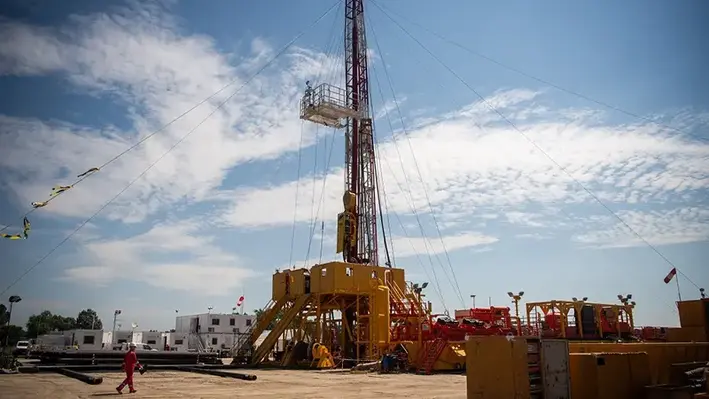
 A subsidiary of MVM has signed a HUF 7.86 billion contract for geothermal drilling and well-testing activities in the Kiskunhalas area, marking a significant step in Hungary’s renewable energy transition.
The project will be implemented over the next three years and will cover several locations across the Great Plain, aiming to unlock the region’s geothermal potential and strengthen domestic energy security.
Contrary to earlier expectations, only one bid was submitted in the public procurement process. The sole bidder—and eventual winner—was a state-owned company, according to information obtained by G7. The winning firm was taken over by the state two years ago, specifically to reinforce the government’s role in “the exploration, exploitation and extraction of geothermal energy.” As outlined in the official documentation, the project’s long-term objective is to establish power plants capable of generating electricity from geothermal sources, thereby reducing reliance on imported energy and lowering carbon dioxide emissions linked to fossil fuel use.
The designated research area spans more than 175 square kilometres, meaning the works will extend beyond Kiskunhalas to include surrounding settlements. These areas include Harkakötöny, Kiskunmajsa, Zsana, Balotaszállás, Kisszállás, and the administrative border of Pusztamérges in Csongrád–Csanád County. This broad geographical scope highlights the strategic importance of geothermal resources across the southern Great Plain.
The programme is managed by Komm Hull Villamosenergia Kereskedő Kft., which holds the geothermal exploration permit for the Kiskunhalas region. Under the newly signed contract, deep geothermal drilling will be carried out, with the first exploration well planned to reach depths of up to 3,500 metres under a turnkey arrangement.
Geothermal energy is playing an increasingly prominent role in Hungary’s national energy policy. Both the National Energy Strategy and the Geothermal Utilisation Concept, completed last year, prioritise the expansion of geothermal capacity. According to the concept, annual geothermal energy use is expected to rise from 6.4 petajoules to 8 petajoules by 2026, and to 12–13 petajoules by 2030. This growth could raise geothermal’s share in total heat production to 12% by 2030 and 25–30% by 2035, potentially replacing up to 1–1.2 billion cubic metres of natural gas annually.
Despite these ambitions, concerns remain. Professional organisations have previously criticised the strategy-making process for limited consultation, and the public procurement outcome—originally intended to involve three bidders but attracting only one—has raised further questions. The contract was awarded to Rotaqua Kft., acquired by the national asset management company at the end of 2023. With decades of experience in deep drilling, including research linked to uranium mining since the 1950s, the company brings significant technical expertise to this landmark geothermal initiative.