
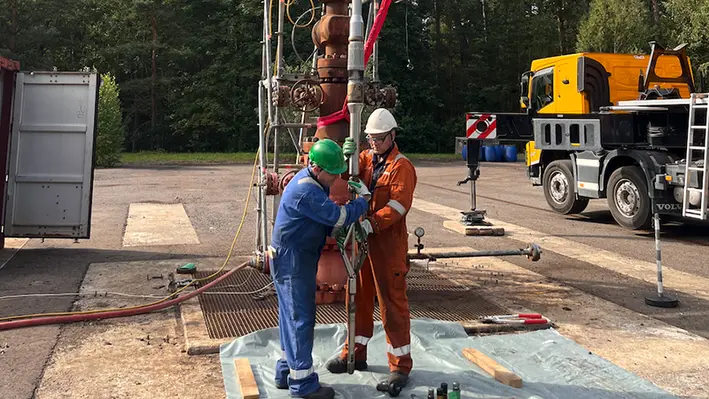
 In Germany, Green Therma and Helmholtz-Zentrum für Geoforschung (GFZ Potsdam) are gearing up to test a technology that could reshape how the world accesses one of its most powerful, yet underused, renewable energy sources: deep geothermal heat.
The location is a quiet research site north of Berlin, beneath the forests of Groß Schönebeck, where scientists have explored the Earth’s heat for decades.
In 2026, the site will host the world’s first installation of Green Therma’s vacuumised pipe completion (DualVac), a new kind of deep geothermal well design engineered to transport heat from more than 3 km below the surface with minimal heat loss.
For the first time, a DualVac completion with a continuous vacuum insulation — used in cutting-edge industrial applications — will be applied inside a single-well co-axial geothermal system.
If it performs as expected, it could dramatically increase the efficiency of deep geothermal operations and unlock renewable heat resources in locations previously considered too challenging or costly.
For Denmark-based Green Therma, it is a moment that has been years in the making.
“This project represents a milestone in geothermal energy extraction technology,” says Jørgen Peter Rasmussen, Founder and CEO at Green Therma.
“By demonstrating DualVac insulation performance at Groß Schönebeck, we are taking a major step toward making deep geothermal heat accessible, efficient, and scalable on a global level.”
The installation will reach depths of over 3 km, where temperatures are above 100 degrees.
Over the course of a year-long test, the system will be measured, monitored and challenged — generating data that could accelerate the deployment of deep geothermal as a local, reliable and carbon-neutral heat source.
For GFZ Potsdam, Germany’s national research centre for earth sciences, the project is another example of how research infrastructure can drive real-world progress in energy transition.
“Close cooperation between industry and research is essential for developing next-generation geothermal solutions,” said Prof. Dr. Ingo Sass, Head of the Geoenergy Section at GFZ Potsdam.
“Partnerships like this are crucial for moving geothermal energy forward.”
According to Green Therma, if the DualVac system proves successful, it could meaningfully lower the barriers to deploying deep geothermal solutions in cities, industrial regions and cold climates.
The collaboration forms part of the European TRANSGEO initiative, which brings together partners from five countries to explore how existing wells across the continent can be repurposed for geothermal heat extraction and storage.
“Groß Schönebeck is one of the places where Europe tests what tomorrow’s geothermal systems could look like,” said Prof. Dr. Hannes Hofmann, TRANSGEO Coordinator.
“The knowledge generated here could help expand geothermal energy in regions that need scalable, clean heat.”