
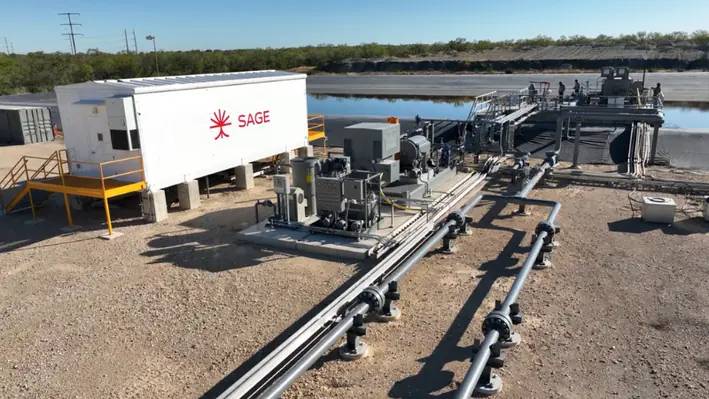
 Sage Geosystems has announced the SMECI facility in South Texas has been placed in service, establishing an important proof point for Sage’s proprietary EGS approach to deliver scalable geothermal power.
Since selling its first electricity in Q2 2026, the facility has been operating for over 120 days to evaluate subsurface pressure response, injection and production performance, water management, system efficiency, and reservoir behaviour. The results met or exceeded Sage’s objectives and demonstrate the company’s ability to engineer an EGS reservoir that repeatedly performs to maximise net power output.
During the 120 days, Sage demonstrated water losses of less than 10% across multiple cycles, indicating that most of the water remains in the system. Sage’s GeoTwin modelling tool also anticipated the operating behaviour observed in the field, reducing uncertainty in future projects and increasing confidence in the bankability and scalability of Sage’s EGS approach.
Cindy Taff, Co-Founder and CEO of Sage Geosystems, said, “Our operating campaign at the SMECI facility demonstrates that Sage’s proprietary EGS approach overcomes one of the industry’s most persistent challenges, high water losses in engineered reservoirs, while delivering the consistent performance required to scale next-generation geothermal. These results validate the core elements of our approach, significantly reduce development risk, and provide a clear path toward reliable, commercial-scale geothermal power.”
Lev Ring, Co-Founder, President and CTO, commented, “Commercial geothermal isn’t just about creating a reservoir; it’s about creating one whose performance can be engineered, predicted, and consistent. That means understanding not only how a reservoir will perform, as we are doing with our GeoTwin modelling tool, but also how efficiently it can retain water and demonstrate a path to losses below 5%. Predictable reservoirs are the foundation of commercially scalable geothermal.”
Sage is now applying the SMECI facility results to the design of future projects, including its planned geothermal development at an Ormat site in Nevada.