
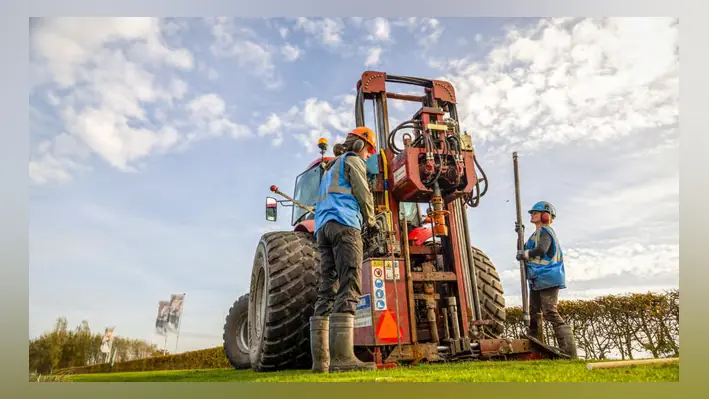
 Vattenfall has published an operational strategy update detailing its push into deep geothermal wells.
Its vision targets the expansion of collective district heating networks to rapidly swap out fossil gas assets ahead of strict 2030 emission caps mandated by the new Dutch Heat Act.
“Geothermal heat and energy is a somewhat untapped source in many parts of the world,” the company, one of Europe’s largest producers and retailers of electricity and heat, noted in a 25th August statement. “For the Netherlands, drilling for, and using, heat from the earth’s subsurface could both relieve the grid and lessen the dependency on imported sources.”
The Netherlands is currently ramping up the development of geothermal energy, it added, with the new Heat Act opening up opportunities for more and larger collective district heating networks, which need fossil-free energy sources.
At the moment around 150 new heat projects are in development round the country, according to Vattenfall.
Geothermal heat – where wells are drilled two to three kilometres into the ground and heat from the Earth’s interior is used for heating production – plays an important role in that development, it added.
“From 2030 onwards, we need to meet the conditions for maximum CO2 emissions set out by the Heat Act,” said Ivo Vos, Project Developer at Vattenfall. “That means that in some heat networks, where we have many fossil-based sources, we need to replace those with sustainable sources. And we need to do it very fast.”
At present, only 11.2% of homes in the Netherlands are heated by something other than gas — geothermal heat, together with sources such as waste heat from data centres, is expected to help increase that figure in the coming years, he added.
Performs extremely well
Vattenfall is currently running four geothermal projects in the Netherlands, in several cases in collaboration with the state-owned energy company EBN, which has been involved in 12 different geothermal projects from 2019.
EBN also runs the so-called SCAN project, in which it investigates and analyses the subsurface to make it easier for companies that later drill the wells.
The results of SCAN are accessible to all geothermal projects in the Netherlands, including where Vattenfall is work in Amsterdam and Almere.
“In terms of the carbon emitted per amount of heat delivered, geothermal performs extremely well,” said Michiel Houwing, Director of Heat Transition at EBN.
“The same is true for the levelised cost of heat that can be provided. It is still a heavily subsidised technology, but nevertheless, with the subsidy, an acceptable tariff can be offered to the end consumer.”
Providing for heat networks
The Netherlands has “very favourable conditions” for geothermal heat, the Vattenfall statement noted.
The sandstones in the subsurface are more porous than the bedrock found in, for example, northern Europe, making it more economically viable to produce hot water from drilled wells, which are often several kilometres deep.
Somewhat paradoxically, the Netherlands’ history of greater dependence on fossil fuels may actually work to its advantage, it added.
“To find the right geothermal locations, we have to understand what the subsurface looks like. Thanks to the Netherlands’ history of oil and gas production, we generally have a good understanding of the subsurface. In and around former oil and gas areas, where seismic data has already been collected, we can make use of that existing data,” said Vos.
Many of those areas have seismically been outside the urban areas where the geothermal heat sources are most needed to provide for the heat networks.
The Scan project was created in part to fill any blind spots in the subsurface knowledge.
Energy independence
For the Netherlands, geothermal heat could provide a double benefit, according to Vattenfall.It would make the country less dependent on predominantly foreign sourced gas for heating, while geothermal heat, which has a naturally high temperature from the outset, requires less additional energy from heat pumps.
For a country with an electricity grid that is under almost constant strain, geothermal heat could therefore offer an important advantage.
“District heating in general, and geothermal heat in particular, allow us to postpone investments in the electricity grid. If everyone in the Netherlands installs and uses heat pumps, it will place enormous pressure on a system that is already under strain. Although heat pumps will sometimes be needed in geothermal heating systems, their impact on the grid will be smaller,” said Houwing.
There is also, Houwing added, an aspect of energy independence.
“Geothermal is a source that makes you less dependent on imports of other energy sources. Geothermal is extremely local, and that makes us less vulnerable. I think that is very important for the country as a whole, and of course also for the energy system. It makes the system more robust.”