
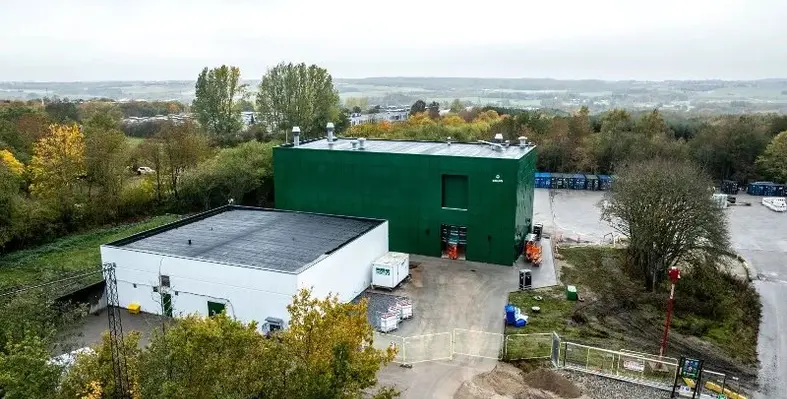
 Aarhus, Denmark, has achieved a major milestone in sustainable heating as the first geothermal heat now flows into homes, marking the start of what will become the largest integrated geothermal district heating system in the European Union.
Developed for Danish utility Kredsløb by geothermal company Innargi, the plant harnesses hot water reservoirs located 2.5 km underground. The extracted heat is channelled through the city’s district heating network, serving around 330,000 residents. When fully operational by 2030, the system will provide approximately 20% of Aarhus’s total heating demand.
“This is a landmark moment. Not only for Aarhus, but for Europe. We’re proving that geothermal energy can be scaled to serve entire cities. It’s local, renewable, and always available. And it’s a key piece in the puzzle to decarbonise heating across the continent,” said Samir Abboud, CEO of Innargi.
A model for Europe’s heating transition
Geothermal energy is one of the four primary renewable sources globally, alongside solar, wind, and hydropower. However, much of Europe has yet to fully utilise its potential. According to the European Commission, geothermal energy could technically supply up to 45% of the heating demand within European district heating networks.
Innargi draws upon extensive oil and gas industry expertise, and the Aarhus project showcases how that experience can be leveraged to unlock geothermal energy’s potential for urban heating.
“This is not just a Danish success story,” said Bjarne Munk Jensen, CEO of Kredsløb. “It’s a blueprint for how cities across Europe can reduce dependence on imported biomass and fossil fuels, while improving energy security and affordability. By tapping into energy close to home, we become less vulnerable to global supply shocks.”
A scalable, low-carbon solution
The Aarhus geothermal facility is the first of several planned by Kredsløb and Innargi, with a total anticipated capacity of at least 102 MW. The project supports Aarhus Municipality’s ambition to achieve CO2 neutrality by 2030 and forms part of a wider transition toward electrified heating solutions such as heat pumps and waste-to-energy systems with carbon capture.
“Geothermal heat is incredibly efficient,” added Bjarne Munk Jensen. “It requires very little electricity to produce large amounts of stable heat. That makes it a perfect complement to other renewable technologies.”
The sandstone layers beneath Aarhus, once beaches that existed 200 million years ago, now serve as a vital resource for building a cleaner and more resilient energy future.